
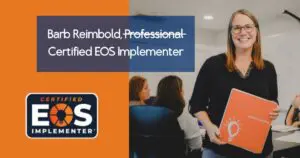
Certified vs. Professional – what does it mean?
If you are reading this, it’s likely you already know what I do – Professional EOS Implementer. However, did you know that there are different tiers of EOS Implementers, based on experience and training? I am thrilled to announce that I have recently taken the next step of my own personal EOS journey and advanced from Professional to Certified EOS Implementer! But what does that mean for me and for you? My Journey Through EOS Perhaps like you, I discovered EOS while trying to better my own business. I did not start out as an EOS Implementer. In fact, for more than 20 years I worked as a business coach for both larger corporations and small to mid-size businesses, helping their leadership teams to improve and get results. Since I am always curious and looking to learn, I discovered the Entrepreneurial Operating System after struggling in my own business. I did my research,
Does Your Business Have a Decision Confidence Issue?
Have you ever experienced one of those days with constant interruptions? People keep popping in looking for your decision on things that were clearly in their realm of accountability. They wait to get a decision from you rather than making the call on their own. Sometimes they don’t tell you they’re waiting, and progress slows until it becomes an issue. When this used to happen to me, I always helped. And, often, after that, I found myself traveling down the “how do I fix this” rabbit hole, getting even further distracted. It’s easy to look at the person at your office door and wonder why they’re even asking. In that moment, remind yourself that this issue really is a two-way street. Sure, the employee has a responsibility to work with you in a productive way. However, you’re on the hook for setting explicit expectations. I am not referring to those
Turn Your Company’s Values Into a Strategic Asset
One of the first steps along a company’s journey with EOS® is defining the values that drive the business forward. Values are foundational to everything else a business does, from hiring the right people to pursuing the right types of customers. Once its values are clearly defined, a team should celebrate. It has just created an important long-term asset for the business. Now it’s time to make use of it. Knowing who you are isn’t always easy Every time I guide new clients through their Vision Building™ exercise, I’m struck by how difficult many people find it. Brainstorming ideas, selecting the most accurate ones, and choosing the right words to express them can take an entire day or even several long sessions. Why is that? There are a few good reasons: Values are somewhat subjective. Before going through the Vision Building process, it’s common for everyone on a team to have
Strategies for Holding Visionaries Accountable
If you’re an Integrator™ this topic is probably on your mind a lot. Visionaries often lean on Integrators to handle tasks the Visionary doesn’t want to do. Nine times out of ten, that includes keeping the Visionary accountable. Most Visionaries I know want to be held accountable for their promises. The key is to find strategies that deliver accountability without sacrificing effectiveness. Why does a Visionary need accountability? As a Certified EOS Implementer® I meet Visionaries with all sorts of personalities. For every daydreamer there’s a hard-nosed pragmatist. For every social butterfly there’s someone else with a reserved style. Nevertheless, certain things are true about most Visionaries: They’re distracted by the future. Most Visionaries get a rush from thinking up new ideas for their business. As a consequence, they can lose sight of the work that’s right in front of them. Rigid processes leave them uninspired. Visionaries need Integrators in part because
Lose Your Inefficiencies, Not Your Mind
Running a business is no simple task. Many entrepreneurs, business owners, and executives find themselves stuck in the weeds of their company’s operations. Whether they’re in the office, hanging out with friends, or spending time with family at home, they can’t escape the lingering questions that stem from their business. How will I put out this fire? How can I open new revenue streams? Can I add another client to my overflowing workload? In this episode of Where There’s a Will There’s a Way, Lauren Carson joins host and EOS Implementer Will Crist to discuss how EOS radically transformed her business. Lauren is the Founder and CEO of Kinect Solar, which sells solar energy equipment on the excess market––in simple terms, it is the TJ Maxx of solar-power equipment. In their conversation, they cover delegating and elevating, living the EOS life, hiring the right people, contributing to the world around them,

The Five Foundational Tools™ and your Golf Bag
Over the past 14 years I have played 1,103 full rounds. Yes, I am obsessed, and people tell me I’m pretty good, and I work at it. I practice daily, take lessons, instructions, read, workout. I do this to make each round amazing for myself and the folks I am spending the day with. I even give free and paid lessons. No, I don’t play in tournaments, I play because I LOVE IT! The other day, I started thinking of the 5 Foundational Tools and the clubs in my golf bag. Background for context: At the age of 5 my father got me into golf, giving me my first walking bag and signing me up for the “Club’s” summer golf program. (The same country club and program US Open Champion Webb Simpson went through as a kid.) Johnny Card was the club pro and he insisted that a bag only include