
The L10 Meeting and the Forgetting Curve: A Structured Approach to Staying Focused and On Track
In the late 19th century, German psychologist Hermann Ebbinghaus embarked on a series of experiments to uncover the secrets of the human memory. He was determined to understand how information is retained and forgotten over time, and he was willing to be his own subject in order to do so. Ebbinghaus created lists of nonsense syllables (such as “WID” or “KOK”) and memorized them. He then tested himself on his recall of the syllables at various intervals of time, ranging from a few minutes to several days. He recorded the number of syllables he was able to recall at each interval and plotted the results in a graph, which became known as the Forgetting Curve. The Forgetting Curve showed that Ebbinghaus forgot most of the information he had learned within the first hour, and the rate of forgetting continued to increase over time. He also found that the rate of

Looking in the Mirror
It’s amazing what we can’t see when we’re in the midst of it. The late mathematician, Kurt Godel, once wrote that you can’t be part of the system and understand the system at the same time. In the midst of touching and feeling, we have no objective perspective. We know what we experience in real time rather than objective reality. I started work with a company that had self-implemented EOS and had never had professional sessions before. They were a group of people trying to get something done, believing their challenges and struggles were unique, but in reality, they are like every other organization out there. The lack of realistic objectivity manifested itself in the following: “We’re unique because of our size. We’re small and therefore have a bunch of resource constraints” This complaint exists in all companies regardless of size “Our industry is different from any other industry, which

Happy Chicken Clucking
When I walk up to the chicken coop, my rooster, Sven, makes a certain sound. It is his way of notifying the flock to “pay attention.” This isn’t a special “Sven” sound as my other roosters would do the same thing. He also makes a sound I call “Happy Chicken.” When I go into the run and leave treats for the flock, Sven will make this excited clucking that sounds like he is really pleased with what I brought them. That sound always makes me smile. But I noticed something funny a few weeks ago. I had just dropped some treats in the run, and Sven seemed happy about it, but then he waddled over to the corner of the run and started making his ”happy chicken” sound – and he was nowhere near the treats I had just dropped. He then picked up a worm and proceeded to drop
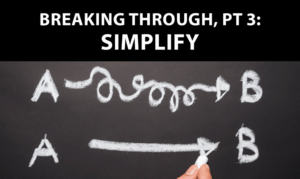
Break Through 3 – Simplify
Simplify is one of The Five Leadership Abilities(TM) taught by EOS Implementers. Combined with the others: Delegate, Predict, Systemize, and Structure, leaders learn and work on what it takes to break through the ceiling. According to Verne Harnish, author of “Scaling Up: How a Few Companies Make It…and Why the Rest Don’t”, “Simplicity is a complex concept to master. But when you do, it is the most powerful lever in business.” Entrepreneurs who simplify their operations reduce stress, increase efficiency, and ultimately achieve better outcomes, and a better life. Complexity can arise from various sources, such as a lack of clear vision, poor organizational structure, and ineffective processes. As businesses grow, this complexity becomes even more challenging. This is why simplification is essential to ensure continued growth and success. EOS helps you create a clear vision, accountability, and improve communication among team members. You will also streamline processes, which ultimately leads

The Issue Is In The Room But No One’s Addressing It
Polite. Amiable. Avoiding. I did not add the word Trust into the mix, as this team’s concept of trust was, “I trust that my colleague will do what they say,” far different from vulnerability-based trust in which we are completely honest and open with our strengths and weaknesses. We can share with others AND accept truth from them. Those 3 words describe the behavior of a client’s leadership team. We’ve worked together for 7 sessions. We recently had our first annual 2-day and started things off by using a tool to measure team health. Their rating was quite low. In fact, it’s one of the lowest team health ratings of any team I’ve worked with. They scored 5 out of 10, somewhere between totally dysfunctional and healthy and cohesive. They were surprised. We went through the session, identified issues, worked through them, and solved them. Everyone was on the same

ELMO: A New Approach to Effective Communication
Effective communication is key to the success of any team. However, many teams struggle with cutting each other off and wasting time talking about unnecessary things. If your week is already full of meetings, it’s frustrating when the team becomes stuck in a loop around a particular topic. With each team member contributing their own information and insights, the discussion may start to feel like a never-ending cycle of repeated points and opinions. This is not only a waste of time, but it can end up hurting your business in the long run, to the point where everyone on your team begins to experience a lack of productivity, and ultimately, a failure to achieve goals. That’s where ELMO comes in: “Enough, Let’s Move On.” During an EOS session, this is when we would throw the horse into play. Stop Your Meetings (and Business) From Going in Circles Many of my clients