

World-Class or Bust? Hire a Business Coach!
Surgeon Atul Gawande once asked the question, “How do professionals get better at what they do?” He observes two views. The first one is the traditional pedagogical view. You go to school, study, practice, learn, and graduate. A professional is someone who is capable of making their own improvement. And this method works. The second view comes out of sports. It says that everyone needs a coach — everyone. Even the greatest professionals in the world need a coach. But expertise means not needing to be coached, doesn’t it? Everyone Needs a Coach Gawande says there are numerous problems in trying to make it on your own. You often can’t see the issues that are getting in your way, and you may not know how to fix them. And somewhere along the way, you stop improving. The best athletes in the world rely on their coaches. Serena Williams, Tiger Woods, Muhammed
5 Ways EOS® Transforms Non-profit Organizations
Tens of thousands of entrepreneurial companies have achieved greater Traction™ and success using the Entrepreneurial Operating System® (EOS®). But what about non-profit organizations, churches and private schools? Can EOS help these organizations to run more effectively and achieve their goals? While EOS was developed with for-profit businesses in mind, the same core principles apply to non-profit organizations that are willing to be innovative and entrepreneurial. If your leadership team is open, honest, and willing to be vulnerable with each other, then you’re the right kind of organization to run on EOS. Any organization that relies on people to do its work can benefit from the Entrepreneurial Operating System. At the end of the day, EOS is designed to harness human energy into one direction. Let’s look at five ways EOS can benefit your non-profit organization 5 Ways EOS Transforms Non-profits 1) Get alignment on mission Perhaps more than any for-profit business, a non-profit is mission-driven.
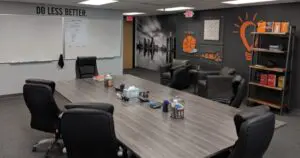
The EOS® Session Room Designed to Make You Feel Like You Matter
I’ve facilitated quarterly and annual sessions in just about every hotel room, casino and conference center in the Detroit area. They all have some exciting features that leadership teams enjoy, but every one of them leaves something to be desired, as well. Sometimes the temperature isn’t right, the table is too small or the chairs aren’t comfortable. The room is too small or too large. They may serve coffee and water but not tea, or they don’t offer healthy snacks. Those details make an enormous difference in an all-day session, and they don’t foster the kind of creativity that you need to make strategic decisions about your company. For years, I’ve wanted to provide a higher quality experience for my EOS clients—and I’m finally able to do that. I’m excited to introduce the new GPS Session Room exclusively for EOS® clients. It’s a beautiful, safe, spacious place where leadership teams can

Yes, You Can Self-Implement EOS®—But SHOULD You?
Certified EOS Implementers® help you navigate the uncharted waters of the Entrepreneurial Operating System®. But you don’t need to hire an Implementer in order to run on EOS®. Many entrepreneurial leadership teams get excited about EOS and start implementing it on their own. As one business owner put it, “(Entrepreneurs) think we can figure anything out—that’s our superpower as well as our kryptonite. So why hire someone when we can just do it ourselves?…EOS seems simple, so we think we can do it without assistance.” Can you self-implement EOS? Yes, probably. EOS is based on simple concepts and a simple process, which is one of the reasons it’s proven to be so powerfully effective. The real question is, Should you self-implement EOS? Just because you can take on the challenge, that doesn’t make it the right decision. Here are four questions to ask your leadership team before you commit to

Can You Afford NOT to Hire an EOS Implementer®?
As the Entrepreneurial Operating System® gains momentum throughout the business world, more and more companies are implementing EOS® themselves instead of hiring a Professional or Certified EOS Implementer®. Often, leadership teams decide to self-implement EOS for financial reasons—it’s not in this year’s budget, or they believe an Implementer is too expensive. Many teams are big on DIY solutions to save money, so self-implementing seems like a no-brainer. But self-implementing EOS in your company could be more costly than you realize. Your leadership team shouldn’t simply ask if you can afford an EOS Implementer, but if you can afford NOT to hire an Implementer. Read more: Why Self-Implementing EOS May Be Holding You Back Lost Revenue Most teams don’t consider the opportunity costs of NOT hiring an EOS Implementer. As a result, they spend years missing out on increased revenue and optimized productivity. Today I met with a self-implementing team that had that issue.

When Self-implementing Leadership Teams Hit the Ceiling (Again)
When Marisa read Gino Wickman’s book Traction, she knew that the Entrepreneurial Operating System® was the solution her small company needed. They had hit the ceiling and weren’t gaining the Traction® she knew they were capable of. EOS® had the structure and tools Marisa’s agency was lacking. She pitched it to her leadership team, and before long they were implementing EOS. She loved the simplicity of the system, and it seemed natural for her to be the one implementing EOS for the team—after all, she was the owner of the company and she had the vision for adopting EOS to begin with. Marisa was also a natural leader, and she was the team member most comfortable in the driver’s seat. Stuck Again But after a couple years of running on EOS, it was clear that the company had hit the ceiling again. While they had gained some Traction and seen