

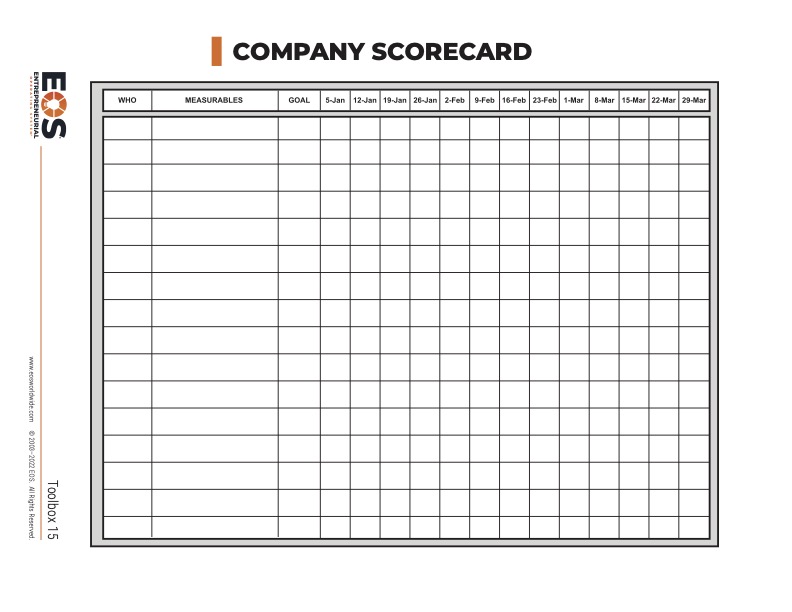
The Scorecard: Why Great Businesses Think Like Great Teams
If you’ve ever watched a high-level sports team—whether it’s the NFL, NBA, or even college athletics—you’ll notice something: they are obsessed with the numbers.
Not just the final score.
Not just wins and losses.
They track everything.
Completion percentage. Turnover ratio. Yards per play. Shot selection. Defensive efficiency. Time of possession. Every stat tells a story, and coaches use those stories to make decisions in real time.
Because the best teams don’t wait until the end of the game to figure out how they’re doing—they know at every moment.
That’s exactly what a business scorecard should do.
Your Business Needs a “Game-Day Dashboard”
A scorecard is not a report you glance at once a month. It’s your real-time pulse.
At its best, a scorecard answers one simple question:
“Are we winning right now?”
And just like in sports, that answer doesn’t come from one number. It comes from a handful of high-impact metrics that reflect the health of the entire system.
Think of it like this:
- Revenue is your scoreboard
- Pipeline is your offensive momentum
- Retention is your defense
- Cash is your stamina
- Activity metrics are your hustle stats
When those numbers are visible and updated consistently, your team stops operating on gut feel—and starts operating on clarity.
What Happens Without a Scorecard
Most businesses don’t lose because of a single catastrophic mistake.
They lose because they didn’t notice the trend early enough.
- Pipeline slowly dries up
- Conversion rates dip
- Customer churn creeps in
- Costs quietly expand
Without a scorecard, these signals get buried in noise or discovered too late—like realizing you’re down three touchdowns in the fourth quarter.
The Discipline of Watching the Right Numbers
Great teams don’t track everything. They track the right things.
The same is true in business.
A strong scorecard:
- Is simple (5–15 key metrics max)
- Is updated consistently (weekly at minimum)
- Is visible to the team
- Drives action, not just awareness
The goal isn’t data overload—it’s alignment.
When everyone knows the numbers, everyone knows what matters.
Where This Really Changes the Game
The real power of a scorecard isn’t reporting—it’s behavior.
When your team sees the numbers every week:
- Sales teams push harder when pipeline dips
- Marketing adjusts faster when lead flow slows
- Operations tightens when margins shrink
Just like athletes adjust mid-game, your team starts making informed, real-time decisions.
That’s how you move from reactive to proactive.
Final Thought
Championship teams don’t guess—they measure, adjust, and execute.
Your business should be no different.
If you don’t have a clear, simple scorecard that your team reviews consistently, you’re essentially playing without a scoreboard.
And in business, just like in sports—
you can’t win if you don’t know the score.