

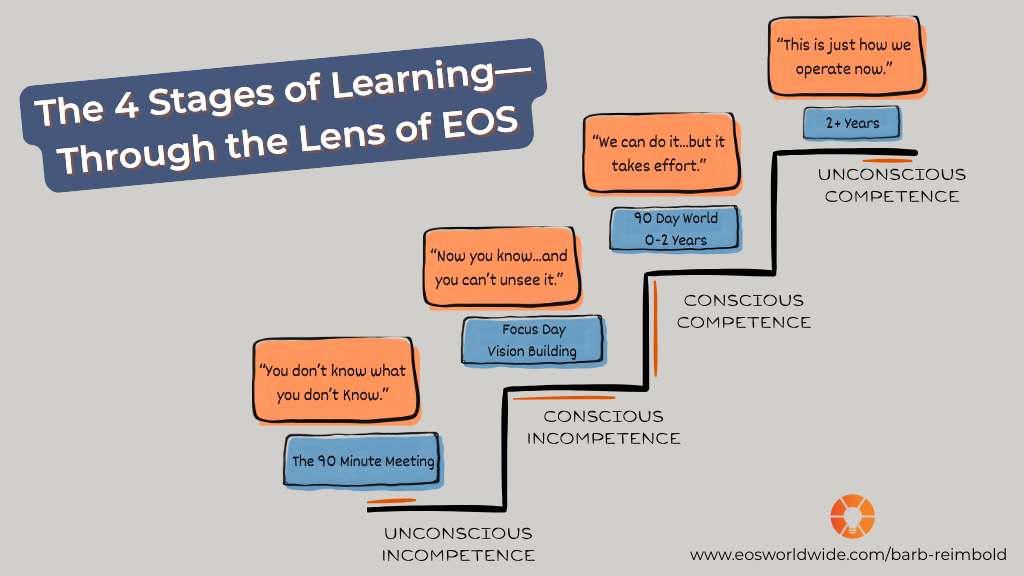
A while back, I came across a Reddit post that got my attention. And then recently it showed up again in a facilitation class I was taking.
It was a simple graphic showing the “4 Stages of Learning” (more formally known as the Four Stages of Competence)—a model originally developed by Noel Burch that maps the emotional and psychological journey we go through when learning something new. You’ve probably seen it before in some form.
But something about the way it was visualized made it click for me in a different way. Almost immediately, I started thinking about how closely it mirrors what I see teams experience as they implement EOS.
Because while EOS is a set of tools and disciplines, it’s also a learning process. And like any meaningful change, it comes with very real emotions along the way.
Here’s how I see those stages show up in an EOS journey.
Stage 1: Ignorance (Unconscious Incompetence)
“You don’t know what you don’t know.”
At this stage, there’s limited awareness of what’s missing. Leaders may feel some pain and realize things aren’t as smooth as they should be, but they don’t yet have language or structure around it.
As an Implementer, I see this stage often align with the 90-Minute Meeting which is often the first, formal introduction a leadership team has to the Entrepreneurial Operating System. For many teams, it’s the moment where things start to click: “Oh… this is why it feels harder than it should.”
There’s a sense of excitement here, along with the feeling of possibility and anticipation.
Finally, there might be a way to make things better.
Stage 2: Awareness (Conscious Incompetence)
“Now you know… and you can’t unsee it.”
This is where things get real. As teams move into Focus Day and the Vision Building Days, they start putting structure around their business—defining roles, setting priorities, building out their Vision/Traction Organizer.
And with that clarity comes awareness. Gaps become visible. Misalignment surfaces. Issues that have been sitting under the surface for years start to come into focus.
This stage can feel uncomfortable and I often see teams experience frustration, feel overwhelmed, and even a bit of discouragement. There’s a moment of, “Are we worse than we thought?”
They’re not. And while this is the messy middle, all this hard work is worth it.
Stage 3: Learning (Conscious Competence)
“We can do it… but it takes effort.”
This is the stage where the real work begins. Teams are now living in a 90-Day World—setting Rocks, running Level 10 Meetings, using their Scorecards, and starting to build new habits.
They know what to do. They’ve seen it work. But it still requires intention.
Running a great meeting doesn’t happen automatically. Solving the right issues takes discipline. Holding each other accountable can feel uncomfortable.
But it’s also the time when they start feeling an important shift. It’s when confidence starts to build. Not because it’s easy—but because it’s working.
Stage 4: Mastery (Unconscious Competence)
“This is just how we operate now.”
After a couple of years of consistently running on EOS, most companies shift from EOS and its tools being something they “do,” to it just being part of how the business runs.
Meetings are more productive without forcing it. People know their roles and take ownership. Issues get solved instead of avoided.
There’s a level of confidence and pride that comes from that consistency. Not because everything is perfect—but because the team knows they have a way to handle whatever comes next.
Bringing It All Together
One of the reasons I like the 4 Stages of Learning as an approximation to running on EOS is that it normalizes the experience. If you’re early in your EOS journey and things feel harder than expected—that’s not a sign something is wrong. It’s a sign you’re in the middle of learning. And if you’re further along, it’s a helpful reminder of how far you’ve come—and what’s possible when you stay consistent.
EOS doesn’t just change how a business operates. It changes how a team thinks, communicates, and works together. And like any meaningful change, that takes time.
So, if you’re in the middle of it… keep going.
If you’re feeling the discomfort of Stage 2, you’re not alone.
If you’re putting in the reps in Stage 3, it’s worth it.
And if you’ve reached Stage 4, you know the impact it can have.
The goal isn’t perfection. It’s progress, consistency, and building something that works—day in and day out.
If this resonates with what you’re seeing in your business, you don’t have to figure it out on your own. I’m always happy to compare notes and share what I’ve seen work—feel free to reach out.