

Turn Unhappy Customers into Enthusiastic Fans
What is one goal all entrepreneurial businesses share? To turn customers into fans and profit. The last thing you want is legitimately unhappy customers: people who have a justified gripe about quality, quantity, outcomes, delivery, service, or any other aspect of the customer lifecycle. When probing such customer dissatisfaction, the root cause is often found to be operational in nature, the result of suboptimal or inconsistent processes. To remediate this situation, work through these four key questions. The first question is “Do we know what the customer wants?” It is tempting to answer this question generically (and somewhat cavalierly) by stating, “A great product and service!” While that is true, it does not inform the development of optimal processes. To garner helpful insights, you need to go deeper, diving into every aspect of the customer experience and listening to your customers’ needs and wants. For example, do you know what your customers want when it
How to Make Your Core Values Part of the Fabric of Your Culture
Once your Leadership Team discovers your company’s Core Values, it’s time to start using them to lay the foundation of your organization’s culture. To do that, you must have a compelling Core Values Speech. If your Core Values are the bricks that form the foundation, the Core Values Speech is the mortar. Without an effective message that communicates them over and over again, the Core Values are just a collection of aspirational ideas with nothing to solidify and hold them together. Your Core Values represent the regular behaviors and character of your best people; those who exemplify the culture you want to build. To drive this home, we as leaders have to do what good parents do to reinforce the kind of behavior they want from their children: Have a simple set of rules, Repeat ourselves often, and “Walk the talk.” So, the Core Values Speech is the primary vehicle you

But, Where Are We Going?
Where will we be 10 years from now?, I asked my husband. It’s a question we discuss frequently. We are no longer spring chickens (well, I still think I am), and defining what is important in life seems to be a consistent theme in our discussions of the future. But I also know myself, and the status quo is not something I feel compelled to accept. So the question I keep asking is, “What’s next?” Now that we are clear on our core focus – sticking to animals that fly – it is time to focus on where we are going long-term. We recently inherited three new chickens and a totally awesome coop built by a professional structural engineer. Those chickens are so sweet – they were clearly raised by a devoted chicken mama and are comfortable around humans and dogs. Last week, one of them actually took some food right out of my hand –

What To Do When You Miss Your Sales Goals
For more than 20 years, I’ve coached business owners and their leadership teams to achieve their goals and see tangible results. Since I’ve been in the business for over 2 decades, I’ve seen all the ups and downs, and not hitting your sales goals is a very common issue. While this is frustrating and disappointing, these setbacks can provide valuable insights and along with your EOS tools, you and your team can get your company back on track toward growth and success. Reflecting On Missed Goals There’s no doubt about it – missing your sales goals doesn’t feel good. However, focusing on the negative and beating yourselves up is unproductive and unhealthy, and can even cause “learned helplessness” among your team, which ultimately just leads to more failure. EOS gives your team the space and tools not only to meet and discuss how and why you fell short but also how
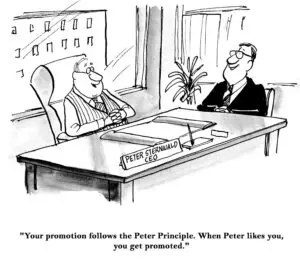
The Peter Principle Has Got to Go
Be in business long enough and you are sure to hear (or perhaps make) a joke about the “Peter Principle.” This is the principle observed by Laurence J. Peter that people in an organization tend to rise to “a level of respective incompetence.” Any time you think to yourself or say to others in disbelief, “How in the world did he/she end up in that position?!” you are probably viewing the Peter Principle in action. When you observe the Peter Principle on your team or in your business (and, yes, it can occur at every level of the organization, right up to the very top), you may roll your eyes and commiserate with your peers over a mid-morning cup of coffee. But the truth is, the Peter Principle is no joke. At its core, the Peter Principle means you do not have the right person in that seat in your company
Why I decided to become an EOS Implementer
First of all, let me just say off the bat that I think life is a project. It has a start date and an end date. There are certain goals, deliverables, jobs to be done. And if you think about your life as a project, it actually makes everything fall into place. Instead of thinking of a job, or even a career as that – it’s a project. This is an idea that I picked up from football coaches, or soccer coaches, you would hear a head coach taking a position, talking about the project, being attracted to the project, with a specific timeframe, and a very focused and definite outcome. Whether it was promotion, winning a trophy, a turnaround, whatever the case may be. So, when I look at my life now, I have several projects that inspire me and take up my time. That gives me purpose that allows