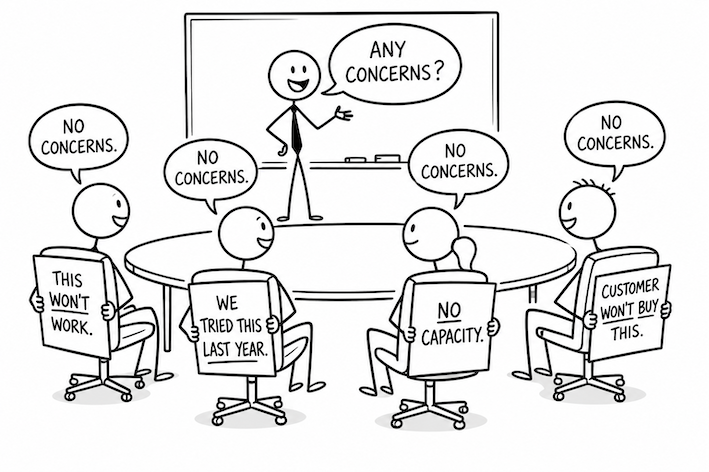
The most dangerous form of misalignment is the one nobody talks about: the illusion of alignment.
On the surface, the team appeared aligned:
- The leader shared priorities.
- Everyone nodded. No objections, debate or conflict.
Then a few weeks later, those same priorities aren’t getting accomplished and the leader becomes frustrated, “Why isn’t this getting done?”
In many teams, people stop challenging ideas long before they stop seeing problems.
They’ve learned that questioning a priority gets labelled as negativity:
- Raising concerns means they’re “not being a team player.”
- Offering a different perspective leads to being pounced on, dismissed, or explained away.
So they stop speaking up. Not because they agree, but because they’ve concluded it isn’t worth the cost.
The result is what I think of as the Illusion of Alignment or False Harmony: everyone appears aligned because nobody is willing to disagree.
The irony is that leaders often interpret silence as commitment when it’s actually withdrawal.
One thing I’ve learned over the years… healthy alignment is noisy.
The best teams challenge assumptions, test ideas, and surface concerns early, and only after the debate do they commit.
If every discussion ends in immediate agreement, it might be worth asking whether you’re seeing alignment…or the illusion of alignment.
One of the simplest leadership tests is this: after sharing a priority, ask “What concerns are we not talking about?” And then don’t talk until at least two other people speak up.
If nobody challenges it, don’t assume alignment. Assume you need more discussion and debate.