

How Queensland businesses can build the operational foundations to capture the economic opportunity from the Brisbane 2032 Olympic and Paralympic Games.
By Mirko Roettgers, Professional EOS Implementer, Brisbane, SEQ, Queensland.
This article summarises findings from the whitepaper “The Green and Gold Runway”, which draws on more than 30 government, industry and academic sources.
The whitepaper is 45-minute in-depth read examining the direct and indirect Brisbane 2032 opportunities, the seven operational challenges most commonly limiting businesses’ access to them, and a systematic, industry-specific approach to addressing each one. It includes complete data sourcing, methodology notes, and a glossary of terms.
INTRODUCTION
The 2032 Brisbane Olympic and Paralympic Games are widely described by economic analysts as one of the more significant catalysts for South East Queensland in recent decades, bringing an estimated $8.1 billion in direct state benefit, a $180 billion regional infrastructure pipeline, and a tourism sector targeting $44 billion in annual value by 2032. Games procurement has also been structured with an explicit small-and-medium-enterprise participation target, with 80% of an estimated $2.5 billion in contracts earmarked for SMEs. At the same time, research into Queensland business conditions indicates that a substantial share of SMEs face structural operational constraints – in cash flow visibility, workforce capacity, and leadership bandwidth – that are unrelated to the Games but relevant to whether a business is positioned to respond to a period of sustained demand growth. This article outlines the scale of the opportunity, summarises the operational challenges most commonly cited in Queensland small business research, and describes the Entrepreneurial Operating System (EOS) as one structured response, as presented in the source whitepaper.
PART 1 – THE OPPORTUNITY
Direct procurement: $2.5 billion in contracts, with a stated SME target
The Brisbane 2032 procurement program opened in late 2025 across more than 50 contract packages, spanning digital infrastructure, event management, branding, security, sustainability services, catering and creative production, among other categories. The Brisbane Organising Committee has stated a policy target of directing 80% of this procurement value toward small and medium enterprises, supported by local-first sourcing frameworks and a dedicated supplier portal, the ICN Gateway.
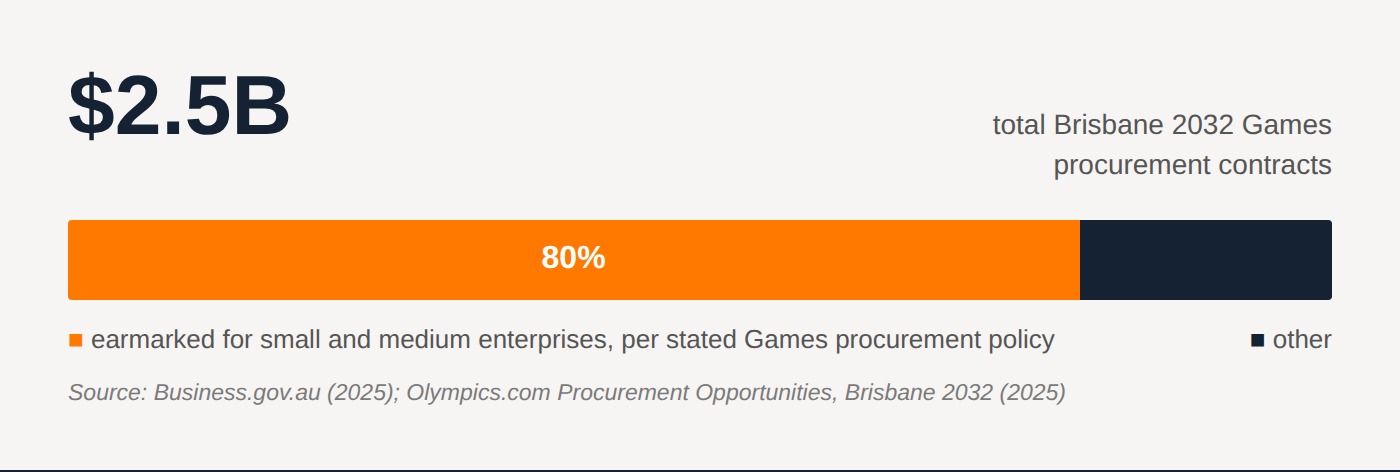
This is a policy commitment rather than a guaranteed outcome for any individual business, and eligibility, competition, and contract-specific requirements still apply. It does, however, represent a different starting position than is typical of large-scale infrastructure or event procurement programs, where SME access has historically been more limited.
Indirect and second-tier opportunity
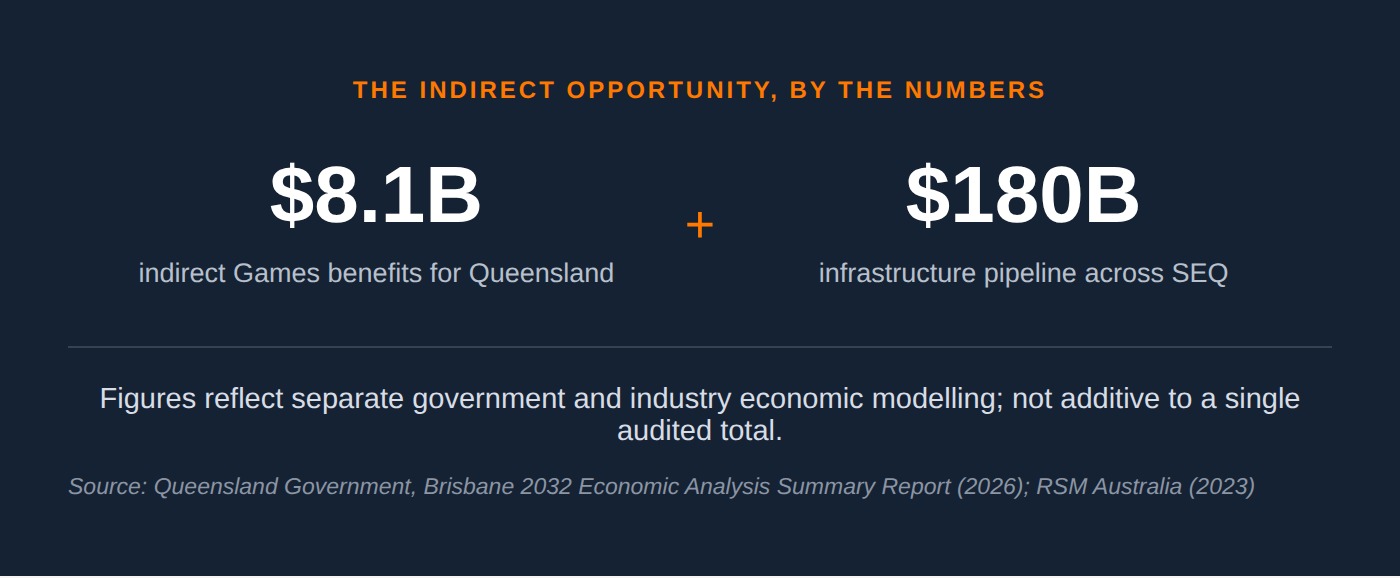
Separate from direct Games contracts, government and industry analysis points to a broader economic effect across the SEQ corridor. The Queensland Government’s economic modelling projects indirect Games-related benefits of $8.1 billion for the state, alongside an estimated $180 billion regional infrastructure pipeline spanning Cross River Rail, Brisbane Airport’s expansion, Queen’s Wharf, the Gabba precinct and Port of Brisbane upgrades. These are distinct estimates from separate modelling exercises and should not be read as a single combined total.
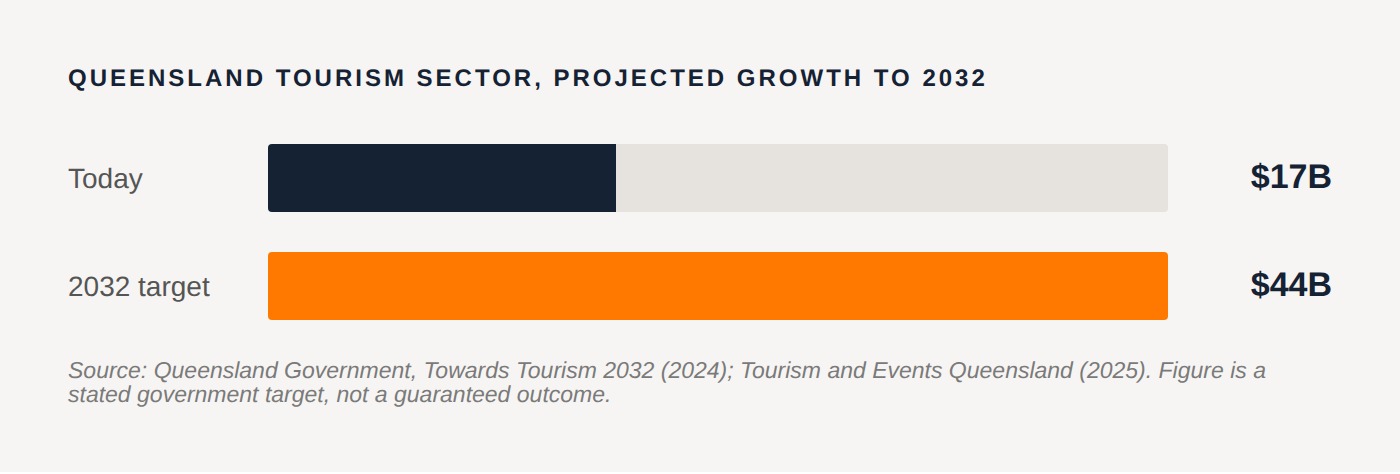
Queensland’s tourism sector, which currently contributes an estimated $17 billion annually, has a stated government target of $44 billion by 2032.
A further category of opportunity, described in supply-chain research from previous host cities, involves subcontracting and service provision to businesses that hold direct Games contracts – legal, financial, marketing, technology and logistics services among them. Research examining the London 2012 Games found that SMEs were more likely to secure work at lower tiers of the supply chain, and that prime contractors under delivery pressure tended to default to suppliers with existing relationships. This suggests that the timing of relationship-building, not only the timing of direct bids, is a relevant variable for businesses considering how to position for the opportunity.
PART 2 – THE CHALLENGES
Seven operational factors identified in Queensland business research
The source whitepaper identifies seven operational challenges that recur across Queensland small business survey data. These are presented as commonly reported conditions, not as universal or predictive of any individual business’s circumstances.
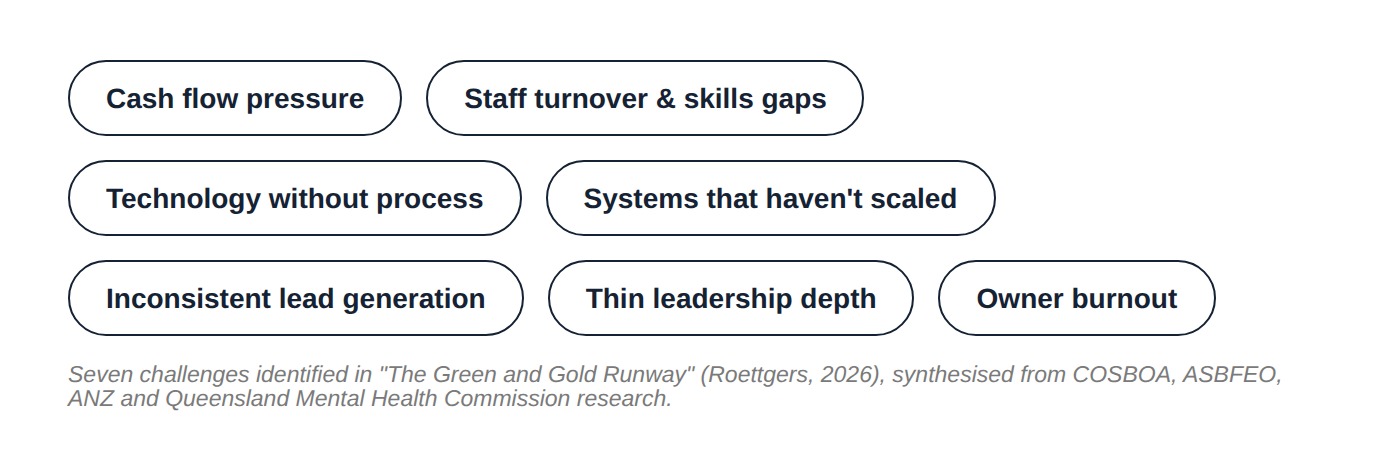 On cash flow, industry survey data indicates that a large majority of Australian small and medium businesses report cash flow difficulty, with a notable proportion holding minimal cash reserves. Businesses that rely primarily on periodic financial reporting rather than more frequent operational metrics may identify emerging cash flow issues later than businesses using shorter reporting cycles.
On workforce capacity, Queensland small business survey data ranks skills shortages and staff turnover among the most commonly cited operational pressures, ahead of cash flow in some survey years. This pressure is likely to be compounded, though not caused, by competition for labour from the broader $180 billion regional infrastructure program.
On leadership capacity, the Australian Small Business and Family Enterprise Ombudsman attributes approximately one quarter of Australian SME failures to insufficient leadership, management and planning capability. Separately, the Queensland Mental Health Commission (2024) reports that a majority of surveyed Queensland small business owners describe ongoing stress, and just over half report symptoms consistent with burnout. These findings are drawn from a specific commission survey and may not generalise to all business owners.
Taken together, this research suggests that operational and leadership capacity constraints are widespread among Queensland SMEs, independent of any single business’s readiness for a specific opportunity such as Brisbane 2032.
PART 3 -THE FIX: AN OPERATING FRAMEWORK
The Entrepreneurial Operating System
The source whitepaper presents the Entrepreneurial Operating System (EOS), a management framework developed by Gino Wickman and described in his book Traction (2012), as one structured response to the challenges outlined above. EOS Worldwide reports that the framework has been implemented in more than 250,000 businesses globally. It organises a business around six components.
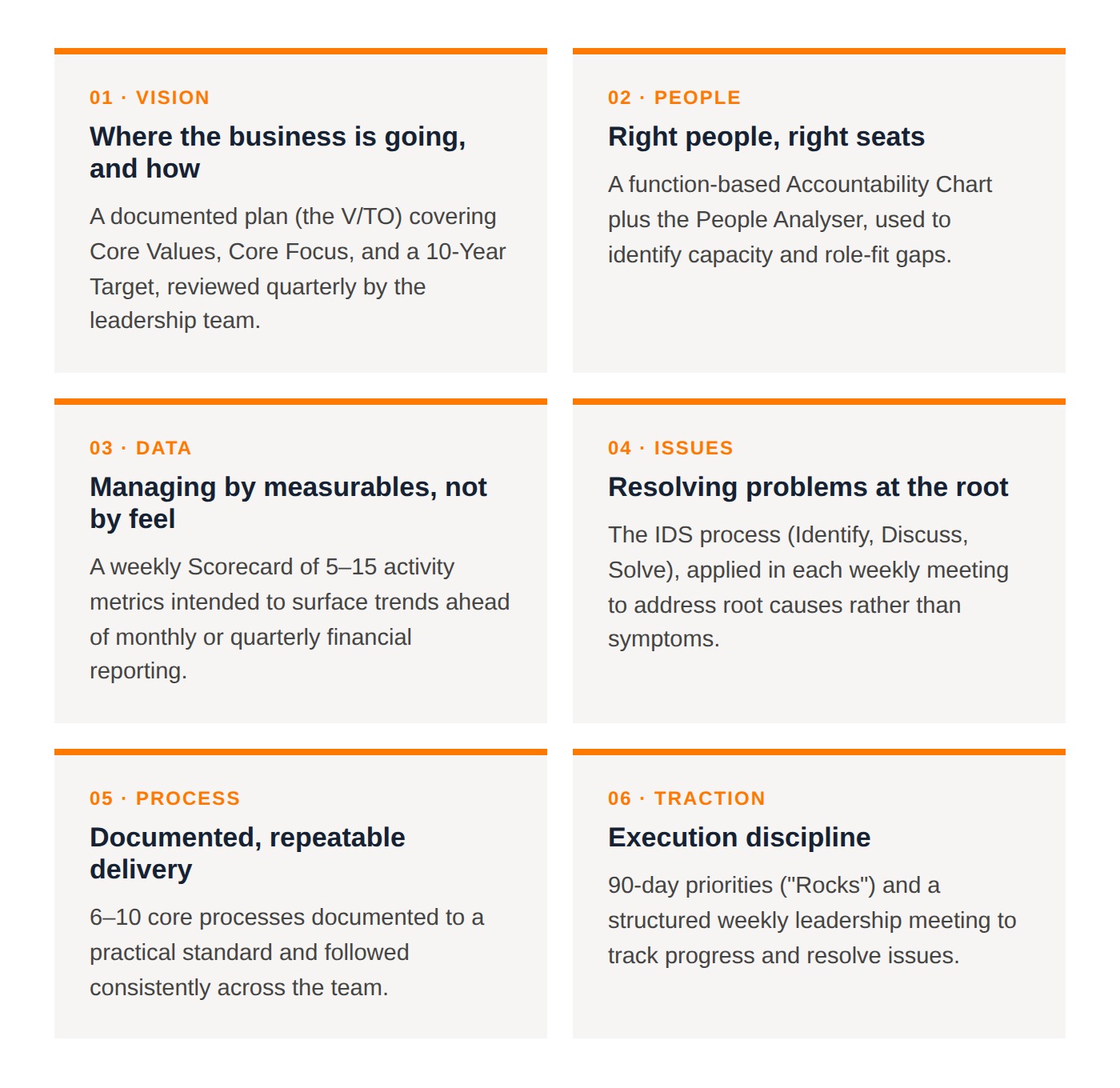 The whitepaper maps each of the seven challenges in Part 2 to a specific EOS component and tool – for example, cash flow visibility to a weekly Scorecard of leading operational metrics, and leadership capacity constraints to a function-based Accountability Chart. The framework’s core claim, as set out in Traction and in EOS Worldwide’s own materials, is that addressing all six components together – rather than any one in isolation – produces more durable operational change than addressing individual symptoms.
Reported outcomes
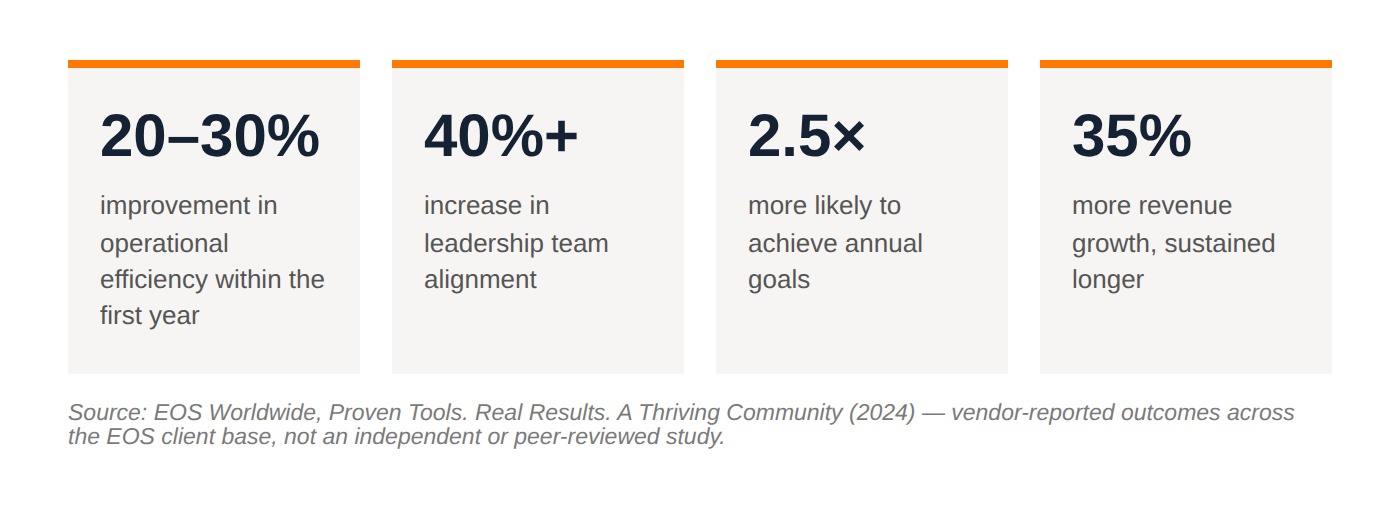
EOS Worldwide publishes a set of outcome statistics drawn from its client base.
PART 4 – THE ROADMAP
A phased implementation timeline
The source whitepaper sets out a phased approach to implementing EOS, mapped against the Brisbane 2032 timeline. This roadmap reflects the general sequence EOS Worldwide describes for its “Proven Process,” applied by the whitepaper’s author to the specific context of the Games preparation window.
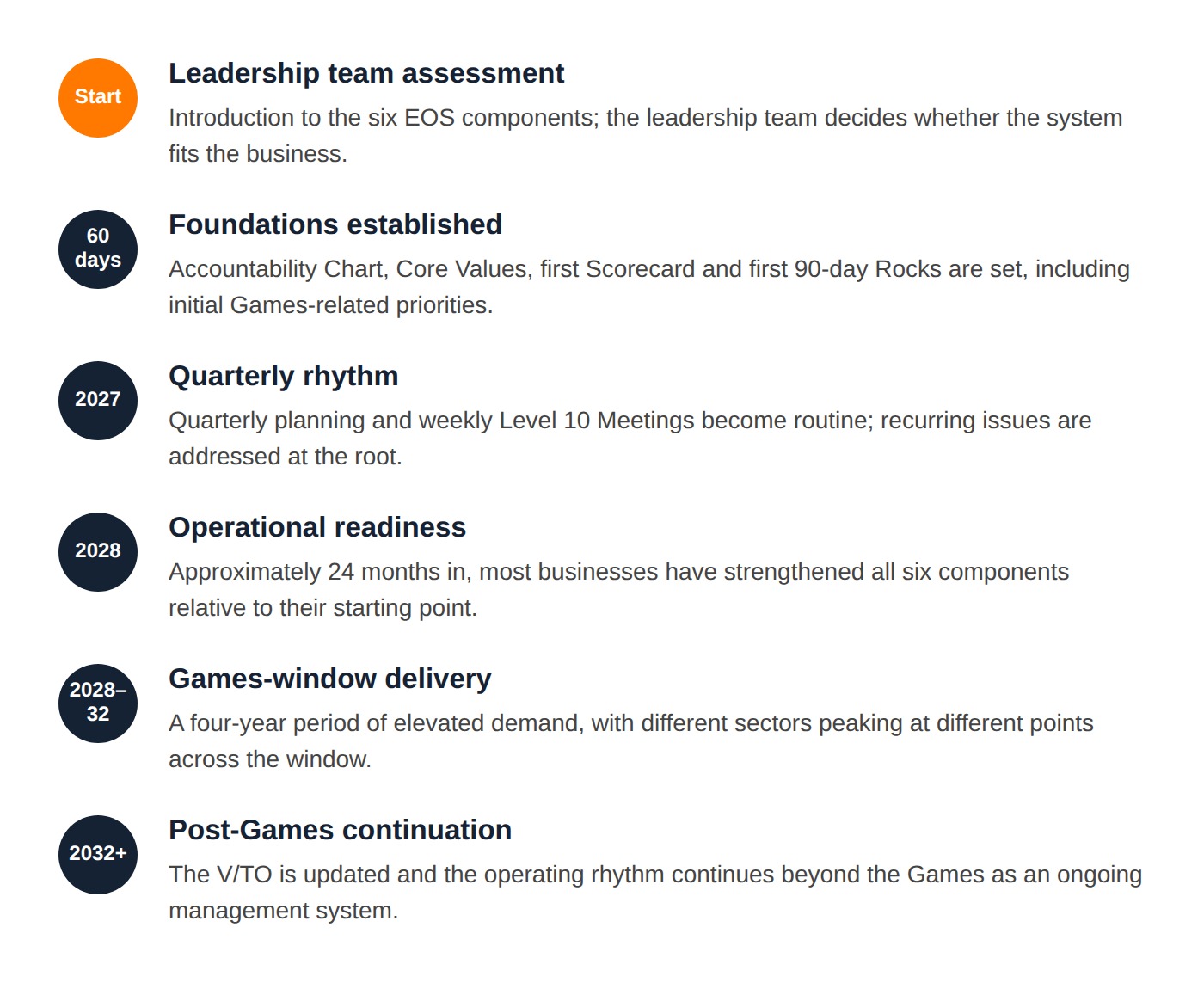
The whitepaper’s central observation on timing draws on qualitative research from previous Olympic host cities, which suggests that businesses reporting sustained post-Games commercial benefit were more commonly those that had established operational systems and commercial relationships in advance of peak demand, rather than during it. This is a pattern observed in prior host-city research rather than a guarantee of outcome for any specific business or city.
CONCLUSION
Brisbane 2032 represents a substantial, well-documented economic opportunity for South East Queensland, with both a direct procurement channel structured to include SMEs and a considerably larger indirect economic effect projected across the region. Separately, Queensland small business research identifies recurring operational constraints – in cash flow management, workforce capacity, and leadership depth -that are independent of the Games but relevant to how effectively a business can respond to a period of sustained demand.
The source whitepaper presents the Entrepreneurial Operating System as one structured framework for addressing these constraints, with the caveat that reported outcome data comes primarily from the framework’s own vendor rather than independent research. The full whitepaper includes the complete reference list, sourcing for every figure cited above, and a detailed breakdown of each of the seven challenges and six EOS components.

About the author
Mirko has over a decade of experience across technology, operations and marketing. Before becoming an Implementer he built and ran his own businesses, served as an accomplished EOS Integrator in the MarTech sector, and held executive leadership roles across multiple professional services verticals – firsthand entrepreneurial experience alongside the structured discipline of enterprise-level leadership.
His work spans marketing, technology and operations transformation, grounded in an MBA paired with real-world operational experience – what he describes as Australian optimism tempered by German precision. It is a combination that makes the hard conversations productive and the practical tools actually stick.
Outside the boardroom, Mirko is an endurance ultramarathon runner who has completed events including Ultra-Trail Kosciuszko – 104km across 3,900m of vertical gain in the Australian Alps. The same principles that get a runner to the finish line apply to business: discipline over motivation, systems over heroics, and showing up when it is hardest.
He works with privately held businesses of 10 to 250 employees that are ready to stop running on gut feel and start running on a proven system.
Mirko Roettgers | Professional EOS Implementer | Brisbane, SEQ, Queensland
