

Most owners build the business they wanted to work in. Then they spend a decade trapped inside it.
It starts honestly. You’re good at the thing, so you go out on your own to do the thing. The homebuilder wants to do it the right way so he starts his own business. The chef opens a restaurant. The arborist buys a truck and a saw. The work you loved becomes the company you own, and for a while the two feel like the same animal.
They stop being the same faster than anyone expects.
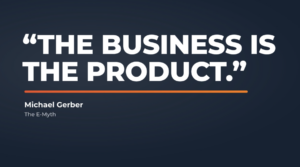
Michael Gerber named this in The E-Myth. He called it “the fatal assumption.” Being good at the work and running a company built on that work are two different skills. One pays you for your hands. The other pays you for your judgment & leadership.
Watch any company that actually runs well and the owner is doing none of the original work. The restaurant owner is off the line. The homebuilder is no longer swinging a hammer. The tree company doing real volume, the owner is not up in the bucket with the saw. The craft got handed off. What’s left in the chair is a different set of tasks entirely: selling, hiring, firing, delegating, deciding where the money goes, and deciding where the whole thing is going. Businesses that scale are lead by owners who are working “on” the business most of the time.
I have sat with leadership teams for twenty years, and the pattern lands the same way every time. The owner who can’t let go of the craft is the constraint on the business, and everyone in the room can feel it before anyone is willing to name it. The owner retreats to the craft because the craft is the one place left where he still feels fully competent. The “on” the business leadership is new, unfamiliar and at least initially…harder. But it is the muscle owners have to work to break through.
The owners who keep retreating to the craft wake up ten years later with the same shop, same hours, no nearer the freedom that sent them out on their own in the first place.
That is the trade nobody mentions when they tell you to follow what you love. What you love got you in the door. It is not what allows you to go on vacation without your cell phone or to sell the business when PE comes calling.
The 33,000 Owners who have implemented EOS know, it’s a proven system to get the 6 key components strong and to establish the right “in” and “on” the business cadence to make the shift.