

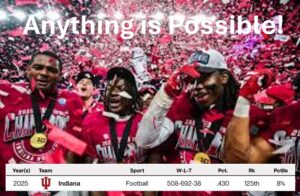
For decades, college football had a predictable set of dominant performers. The powerhouse programs built sustainable advantages brick by brick: massive stadiums, deep recruiting budgets, luxurious training facilities, national TV exposure, recognizable brands, and pipelines into the best high schools in America. Programs like Alabama, Ohio State, Georgia, and Texas invested hundreds of millions of dollars over generations to create machines designed to dominate forever. Meanwhile, schools that failed to invest wound up with weaker traditions. The occasional foray into excellence was exiting, but teams like Kansas, Vanderbilt, and Indiana were largely expected to stay in the background and couldn’t consistently challenge the established leaders.
Then came two market disrupters that flipped the entire sport upside down: NIL and the transfer portal.
Almost overnight, the rules changed. College players now had full-time free agency. Athletes could earn money from their name, image, and likeness. The disruption was striking. Offseasons became musical chairs; coaches lacked clear insight into what a team would look like from year to year. And the payouts to compensate athletes quickly morphed from a cut of the money from selling a jersey with a player’s name on it to big checks for a commercial pitching some booster’s car dealership to outright paying the players.
Suddenly, a program no longer needed thirty years of momentum and a nine-figure investment to compete. Any school with vision, urgency, and a smart strategy could assemble elite talent in a single offseason. Programs that had spent decades perfecting traditional recruiting suddenly found themselves vulnerable to schools willing to adapt faster and put more money in front of coin-operated players. The ticket to the dance was suddenly cheap – the amount of money required to compete at the highest level in this new system was tiny compared to what the traditional powers had invested over generations.
Hey small and medium sized businesses – is this ringing a bell? It should!
For years, big companies enjoyed the same kind of advantages as college football blue bloods. They had larger marketing budgets, stronger brand recognition, deeper customer relationships, bigger sales teams, and operational scale that smaller competitors simply could not match. Entire industries felt locked up. But history repeatedly shows that seismic shifts can suddenly rewrite the rules of competition. The internet did it. Social media did it. Cloud computing did it. And, AI is doing it right now. In each case, smaller, faster companies gained access to tools and capabilities that once belonged only to giant enterprises.
The businesses that win during these shifts are rarely the ones with the most history. They are the ones most prepared to move when the opening appears. Smaller companies should not spend all their energy trying to imitate large competitors. Instead, they should build organizational agility. That means staying lean enough to pivot quickly, maintaining strong cash discipline so opportunities can be seized fast, investing in adaptable technology, and fostering cultures that embrace experimentation rather than fear it. In the NIL/Transfer Portal era of business, speed and agility often beat size.
Artificial intelligence may become the biggest equalizer yet. A ten-person company can now create marketing campaigns that once required agencies, automate workflows that once required departments, and analyze customer data with tools previously reserved for Fortune 500 firms. Distribution is changing too. A single viral video, niche community, creator partnership, or innovative customer experience can suddenly put a smaller brand in direct competition with an industry giant. Just as the transfer portal allowed overlooked football programs to instantly upgrade talent, technology is allowing smaller businesses to acquire capabilities at unprecedented speed and affordability.
But there is an important lesson from college football: opportunity alone is not enough. The programs succeeding in the new landscape are the ones that recognized the shift early and acted decisively. They had infrastructure ready. They built donor networks. They adapted culturally. They stopped clinging to “the way things used to work.” Small businesses should take the same approach. The next market disruption may arrive faster than expected. Companies that stay curious, invest in learning, maintain flexibility, and avoid bureaucratic paralysis will be positioned to capitalize while larger competitors struggle to adjust.
The beauty of disruption is that it does not ask permission from the incumbents. Somewhere right now, in both college football and business, organizations that were once considered irrelevant are preparing to compete with giants. Not because they suddenly became bigger, but because the rules changed. The next seismic shift in your industry may already be forming beneath your feet. The question is not whether disruption is coming. The question is whether your business will recognize the opening quickly enough to run through it.