

In September, I stepped into a leadership experience that quietly rearranged something deep inside me.
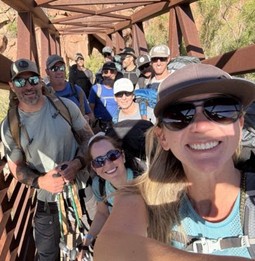
I attended a Crucible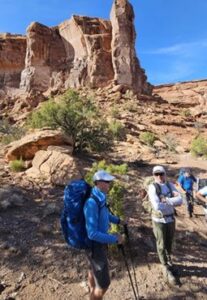 led by Jan Rutherford, founder of Self-Reliant Leadership – not as a leader, but simply as a participant. Nine strangers met at a trailhead in western Colorado and spent four days hiking through Dominguez Canyon: one day in, one day up to a plateau, one day back down, and one day out. I was the oldest participant on that Crucible. That mattered: not as a limitation, but as context.
Our group was intentionally assembled to create cross-learning: five business executives and four retiring Special Forces leaders. Each day, a business executive partnered with a military leader to guide the team. Jan and Jason, our facilitators, stayed intentionally in the background. They trusted the process (and trusted us) to become a self-directed team.
Before the trip, I had read From Strength to Strength by Arthur Brooks. 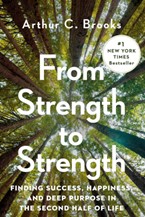 At the time, I didn’t realize how personally relevant it would become.
Brooks describes a transition many of us face as we age: moving from fluid intelligence – speed, drive, problem-solving – to crystallized intelligence – wisdom, perspective, discernment, and service. I understood the idea intellectually. The Crucible made it real.
Early on, the trail began telling the truth.
We learned how to partner with strangers and co-lead – sometimes with people far more experienced, sometimes with those far less. In the process, strangers became collaborators, and collaborators became friends. There was laughter on the trail – the kind that only happens when people feel safe enough to be themselves.
Several of the business executives had never backpacked before. There was real anxiety about leading others with significantly more wilderness and leadership experience. The trail itself added pressure: learning how to carry packs, water scarcity, steep climbs, sore feet. And yet, not once did the team falter. Support was constant. Encouragement was generous. No one was left behind –physically or emotionally.
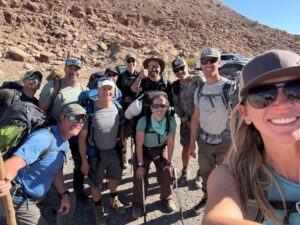
I found myself walking alongside teammates at different points, listening to their stories, their families, what they carried beneath the surface. I wasn’t trying to lead. I was simply present.
What struck me about the four military leaders was not just their competence, but their character. They carried authority lightly. They were humble, generous, deeply human – and deeply devoted to their families.
On the second-to-last day, we spent three hours completely alone with our thoughts. No agenda. No talking. Just stillness.
What I found there wasn’t anxiety or regret. It was peace. A settled clarity.
In that quiet, I realized how much this season of my life is about presence rather than performance. About discernment rather than drive. About offering calm and perspective when others need it most. That stillness confirmed something important: this stage of life isn’t about diminishing relevance – it’s about a different kind of contribution.
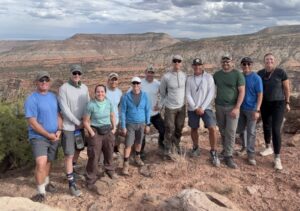
On our final night, we gathered for an Appreciation Circle around the campfire. One by one, each person received feedback from the other eight. It was raw, emotional, and deeply life-giving.
One of the military leaders shared that he had never received that kind of affirmation in his entire life. There were tears around the fire.
When it was my turn, the feedback had a different tone. People spoke about how I had walked alongside them, listened, encouraged them, and created space for them to be seen. That was the moment it clicked.
Without trying – without even realizing it—I had been living out of my crystallized intelligence. Not by solving problems or pushing outcomes, but by loving people well. By listening. By serving.
Being the oldest in the group wasn’t incidental. Age had shaped how I showed up. I wasn’t there to prove anything. I was there to support the team. Until that moment, I hadn’t fully seen it.
By the time we hiked out, nine individuals had become a unified, high-performing team. At one point on the plateau, we chose unity over accomplishment – staying together rather than pushing ahead. What followed was one of the richest conversations of the entire journey.
I told Jan afterward that this Crucible ranked among the top five leadership experiences of my life.
What I carry forward is simple and strong:
There is a profound power in embracing the season you’re in.
There is nothing lesser about crystallized intelligence.
And there is a deep purpose in using it intentionally – for wisdom, encouragement, and service.
If you feel less urgency to prove and more desire to give, pay attention.
You may not be losing strength at all. You may be stepping fully into it.
–Ken