Most annual planning sessions fail before the year even starts.
The team doesn’t lack ideas. They walk in with a spreadsheet and call it a plan.
A budget tells you what you’re allowed to spend. It doesn’t tell your team what to say no to in March.
The spreadsheet trap
Every fall, leadership teams reach for the numbers first. Revenue targets, expense lines and headcount feel concrete, so they become the agenda. Everyone nods at the final version and walks out of the room with a slightly different picture of what matters most. By spring, those differences show up as competing priorities, stalled projects and the same debates the team thought it had settled in December. Eventually the decisions drift back to the founder, which is exactly what the planning session was supposed to prevent.
What I learned from the founder’s chair
Before I ever implemented EOS for another company, I sat through annual planning as a founder. The fiscal year before we implemented EOS, our head of finance presented us with a budget, and we all just said, “That looks good.” By the end of Q1, we scrapped that budget and were making decisions based on pure gut.
The year after we implemented EOS, we had a clear one year plan with numbers and goals based on a clear 3-Year Picture we all could visualize. We had clear, aligned goals for the year that helped us build a budget that allowed us to achieve the goals we set out to achieve.
That experience taught me that a plan only holds when every leader can explain it in the same words, and that the conversation matters far more than the document it produces.
What aligned teams do differently
The teams that walk into next year with real clarity do it differently.
They get out of the business for two days, away from the daily noise that crowds out long-term thinking. They get honest about what worked and what didn’t, including the uncomfortable parts nobody wanted to raise in a weekly meeting. They work on team health and get clear on their blind spots, because a leadership team that can’t disagree openly will never commit fully.
They agree on where the company needs to be in three years, then work backward to what has to be true by December 31. Then they pick the handful of things that actually matter in the next 90 days and put a name next to each one. A priority without an owner is a wish, and aligned teams leave with very few wishes.
A simple test before your session
Before your team plans next year, try this exercise with your leadership team.
- Ask each leader to write a bulleted list of what the organization will look in three years.
- Ask each leader to list the three most important priorities for the first quarter, then count how many overlap.
- Ask each leader to name one thing the company should stop doing next year.
If the answers line up, your session can move quickly to the plan. If they don’t, you’ve found where the real work is, and the session should start with alignment before anyone opens a spreadsheet.
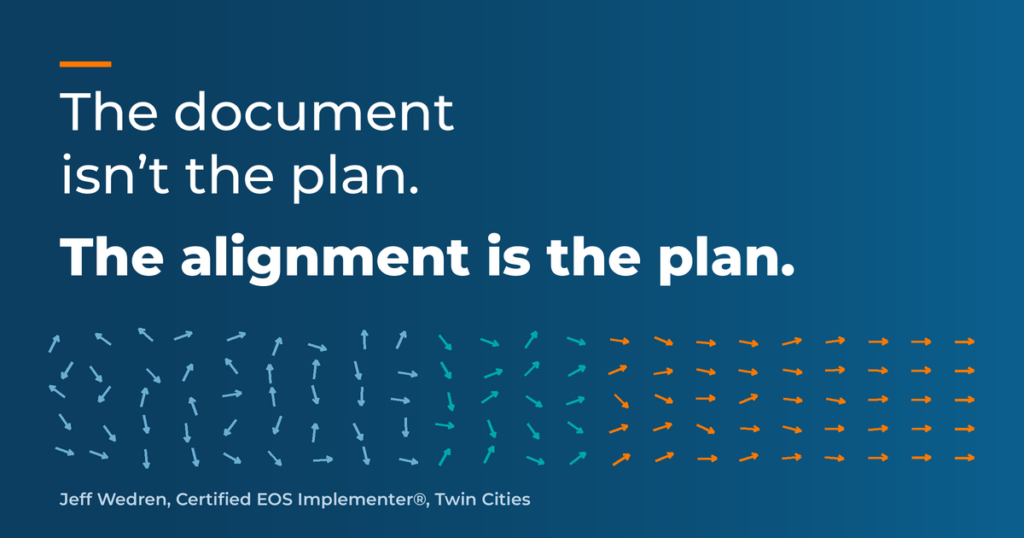
The document isn’t the plan. The alignment is the plan.
About Jeff Wedren
Jeff Wedren is a Certified EOS Implementer® in the Twin Cities and one of Gino Wickman’s first EOS clients. He works with founder-led companies of 10 to 250 people in property management, manufacturing, construction, professional services and consumer products. Visit Jeff’s profile or book a free introductory call to talk about your next planning session.